Overview
I had the chance to work with BMW Designworks on a speculative project exploring how AR could redefine the future of autonomous mobility, It was one of those experiences that pushed me creatively, helped me get comfortable with ambiguity, and let me collaborate with incredibly talented people thinking far into the future.
Out of that process, my team and I created Gozo Trivia—a location-aware AR experience that turns everyday travel into playful, shared moments sparked by real-world landmarks.
Role
UX/UI Designer
Timeline
Feb 2025 – April 2025
(6 weeks)
My Responsibilities
UX/UI Design
Visual System
UX Research
Design Thinking
Team
Lois Kim
Michelle Cheng
Celia Choi
Arthur Jensen
My Impact
I collaborated with four other designers, with guidance from the BMW Designworks team, to explore how AR could enhance the autonomous vehicle experience.
One of my key contributions was proposing the concept of transforming autonomous vehicle windows into interactive AR-enabled displays. This idea emerged from our early explorations and ultimately became the solution our team chose to develop further.
I also helped design the core experience flows and built high-fidelity Figma prototypes that demonstrated how Gozo Trivia would work inside an autonomous vehicle.
Problem
Despite autonomous vehicles creating new opportunities for shared space, most riders will spend their travel time in isolation whether on their phones, zoned out, or disengaged from the people next to them.
PAIN POINTS
Fragmented Connection
Modern families value quality time, yet struggle to actually spend it together. Even when they share a ride, attention is often split across devices.
Passive Travel Time
Autonomous vehicles remove the need to focus on the road, but the freed-up time often lacks meaningful activities that encourage interaction.
Missed Opportunities for Engagement
Without intentional design, the interior of an autonomous vehicle becomes another idle environment, rather than a space that supports shared discovery or play.
Solution
Gozo Trivia is an AR experience that uses real-world landmarks to trigger playful trivia questions that spark curiosity, conversation, and connection between riders.
Integrated across onboarding, gameplay, and post-ride engagement, the system transforms everyday travel into a fun, interactive opportunity.
KEY INTERACTION TOUCHPOINTS
Main Dashboard
Gozo Trivia AR Windows/Experience
Rewind the Ride
OUTCOME (UPDATE THIS)
This solution helps users quickly find relevant content, explore areas of interest, and stay engaged longer with the archive's collection.
Main Dashboard
Passengers personalize their ride using the central console to play collaborative games like Gozo Trivia or view a real-time map of their journey.
The console also includes a compartment that charges, sanitizes, and securely stores personal devices to promote a phone-free experience.
Encourages Collaboration
Supports Digital Wellbeing
Centralized Ride Control

Gozo Trivia AR Experience
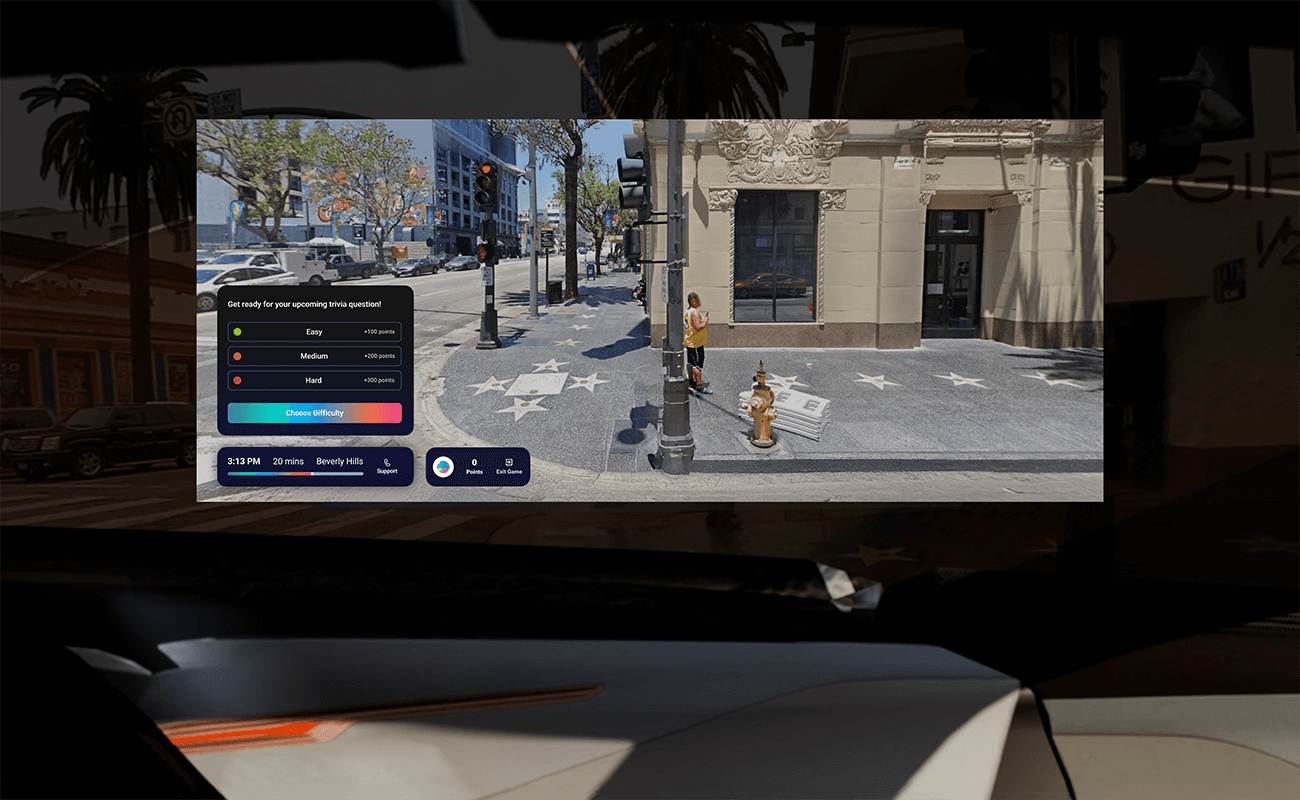
An AR-based trivia game that transforms the outside world into a playground of discovery. As the vehicle passes real-world landmarks, the windows light up with interactive trivia prompts to invite passengers to answer collaboratively.
Landmark-Activated Gameplay
Encourages Family Connection
Turns Transit into Play

Rewind the Ride
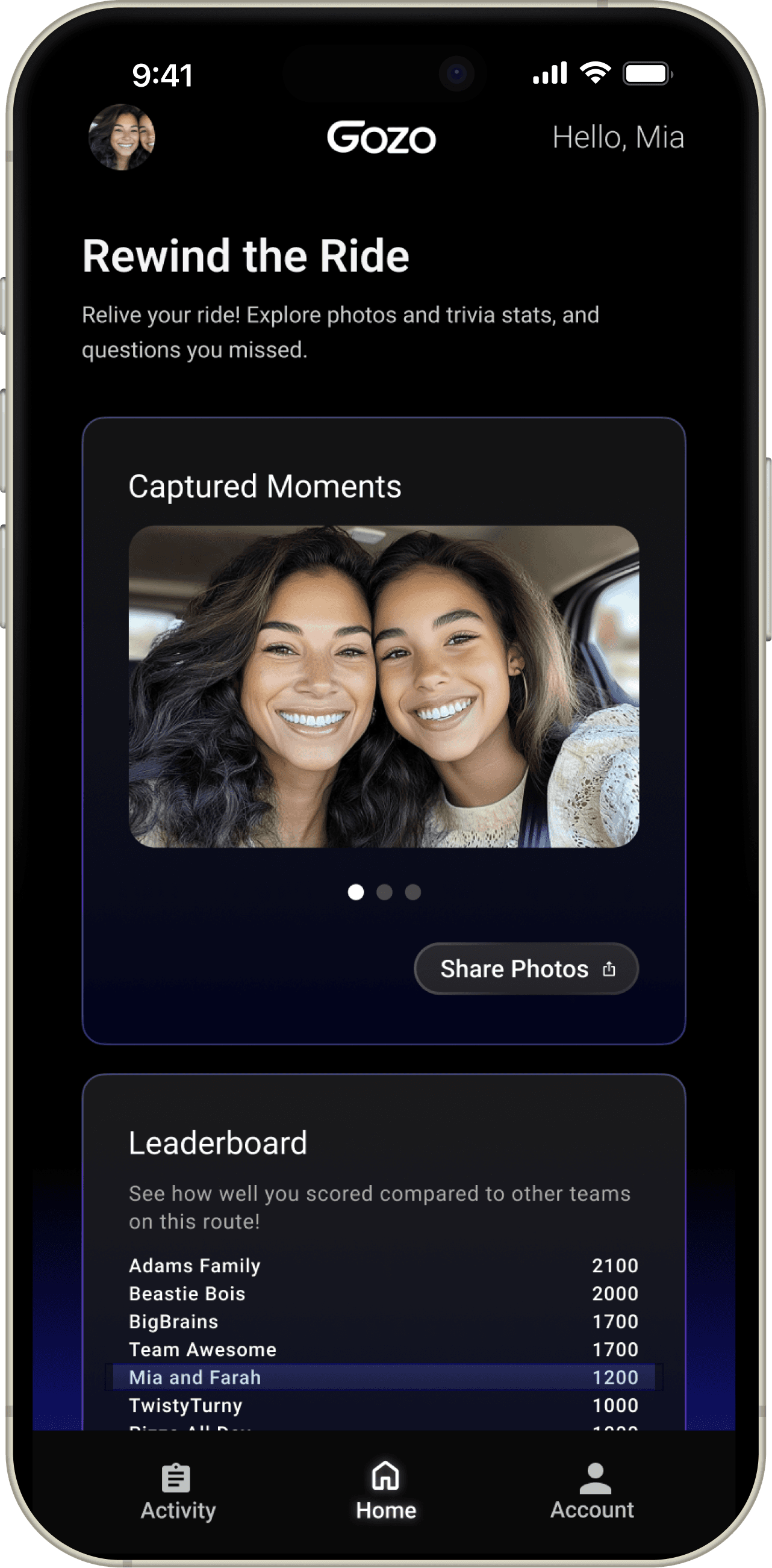
After the journey, passengers can relive their favorite moments through the Gozo mobile app. This feature highlights completed routes, trivia questions, and memorable interactions that extend beyond the ride itself.
Post-Ride Reflection
Encourages Continued Engagement
Bridges Physical and Digital
Design Approach
We approached this challenge by first trying to understand what autonomous vehicles could make possible beyond just transportation. Instead of asking, "What can we build?" we focused on, "What could genuinely bring people closer together during a ride?"
Understanding How Families Use Travel Time
This meant looking closely at how families currently spend time in cars, why moments of connection are so limited, and how emerging AR technology could help shift that dynamic. We explored three different interaction models: ambient displays, mobile tie-ins, and gesture-based features. However, we kept returning to one insight: the windows were the most natural, shared touchpoint inside the vehicle.
Exploring Interaction Possibilities with AR
From there. we prototyped different ways riders might interact with AR on the windows, experimenting with timing, game mechanics, and screen behavior. This helped us understand what actually felt intuitive, fun, and device-free. With each interaction, we refined the experience to feel playful without being overwhelming and interactive without requiring any technical learning curve.
Arriving at a Clear Direction
Through this exploration, the idea of Gozo Trivia became clear: a simple shared AR experience triggered by the world outside that's designed to bring people together through curiosity and conversation.
Refining the Experience Through Usability Testing
Across three rounds of usability testing with peers, professors, and the BMW Designworks team, we refined the interaction model to remove friction and make the experience feel intuitive. Early tests revealed that our text-heavy "How to Play" screen overwhelmed users, which pushed to create a more visually engaging tutorial. We also moved the route map from the AR window to the main dashboard after participants struggled to manage both spatial information and gameplay at once.
Midway through testing, we made several pivotal changes:
Converting the landmark trigger from a manual tap to an automatic activation
Redesigning how hints appear so they're noticeable without being distracting
Moving away from the inaccessible glass-morphism style
These adjustments made the experience simpler. more readable, and far less stressful during a moving ride.
In the final round, users expressed confusion about how the ride concluded. So we designed a finishing screen that better bridges gameplay into the "Rewind the Ride" feature. Through each test cycle, the experience became clearer, more cohesive, and better aligned with the goal of creating shared moments inside the vehicle.